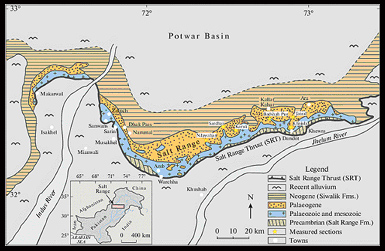
|
G. Cotter, after
considering all arguments pro and con, said he favored a pre-Cambrian age for
the Salt Range Formation. But before his paper expressing this view went to
press (in 1931) Cotter examined occurrences of nummulites, fossil formanifera
typical of the Tertiary, discovered by E.R. Gee in the salt marl at Khewra.
Cotter, who had originally thought they had been washed into the Salt Range
Formation from younger deposits, decided they were native to the Salt Range
Formation. In a footnote added to his paper before publication, Cotter reversed
the position stated in the paper and declared the Salt Range Formation to be
Tertiary. But he regarded it as intrusive, which would explain its position
beneath the Cambrian Purple Sandstone. According to Cotter, the plastic salt,
of Eocene age, was somehow squeezed by geological pressure and other forces
into an abnormal position.
BACK TO DOORS BACK TO HOME 
|