2018
South Africa lectures
On
Monday April 9, 2018 I took an overnight flight from
Los Angeles to Zurich,
Switzerland. From there I took another overnight flight to Johannesburg, South
Africa, arriving the morning of Wednesday,
April 11. I was going to South Africa
to give a talk at the Ubuntu Festival,
organized by Michael Tellinger,
who has
done archeological research showing there was an advanced human
presence in
South Africa hundreds of thousands of years ago. Ubuntu is a Bantu word
that
refers to the universal bond of sharing that connects all
humanity.
Several speakers and
musicians who would be participating in
the conference were arriving that morning at the airport. We were met
by Emma,
Michael Tellinger's fiance. Emma took me to the veranda of the airport
hotel,
where I hung out with other speakers and musicians, conversing until we
had all
arrived. Then we piled into a chartered small bus, about 20 of us, for
the four
hour ride to Mbombela, the
town where the Ubuntu Festival was held, at a sports
stadium. The festival featured
music on a stage, vendor booths, and
lectures in meeting rooms. My lecture was titled Human Antiquity, Origins, and
Purpose. In the first part of the lecture, I presented
archeological evidence
for extreme human antiquity, as documented in my book Forbidden
Archeology.
This evidence, which shows humans like us existed millions of years
ago, going
back to the very beginnings of life on earth, is consistent with the
accounts of extreme human antiquity
found in the Puranas, the
historical writings of ancient India. The evidence
suggests the need for a new explanation of human origins, which I
presented in
the second part of my talk. Briefly, we are not machines made of
matter.
Originally we are beings of pure consciousness, from a higher level of
reality. We did not evolve up from
matter; instead we have devolved, or come down from the level of pure
consciousness. Matter does not produce consciousness, but consciousness
can
become associated with matter. I presented some of the scientific
evidence for
this, from my book Human
Devolution. In the third part of my talk, I proposed
that the real purpose of human life is to restore consciousness to its
original
pure state, while satisfying our material needs in the most simple,
efficient,
and fair way possible.
It was good meeting some
of the other researchers, such as Sam
Osmanagic,
head of the Bosnian pyramid project, and Robert Salas, a former
United States Air Force officer, who, while serving as part of a launch
crew
for several nuclear missiles, experienced a UFO incident that
temporarily
disabled the missiles.
On
Monday April 16
it was
time for me
to get on
another chartered bus with a group of conference speakers and musicians
for the
ride back to Johannesburg and my return flight, by way of Zurich, to
LA.
Seattle Visit
Speaking at the
Phinney Center in Seattle
On August 24, 2018 I gave
a talk about my book
My Science, My Religion at the Phinney Community Center in Seattle, Washington. My Science, My
Religion is a collection of 24 papers I
have presented about my work at major international scientific
conferences. In these
papers I integrate my spirituality, rooted in the philosophy and
cosmology of
ancient India, with my research into the science of human origins and
antiquity. Some people, who are convinced that science and religion
must be
kept completely separate, are surprised I have been able to do this.
Most of the
papers are related to archeological evidence for extreme human
antiquity. Most
scientists believe humans like us first appeared about 200,000 years
ago. But
the Puranas,
the historical writings of ancient India, say that humans have
existed for many millions of years, going back to the very beginnings
of life
on earth. The event began with some bhajan (singing of mantras to
musical
accompaniment). Beforehand, I met with some local supporters at Cafe
Flora, a
Seattle vegan restaurant. I always like coming to Seattle. I gave one
of my
very first public lectures on my work at the Seattle Metaphysical Library.
St Louis
On
Tuesday September 11, 2018, I
flew from Los Angeles to St. Louis.
During my visit, I stayed at the center of the International Society
for Krishna Consciousness (ISKCON), of which I am a member. My main
purpose in St. Louis was to give lectures at
universities on my book Forbidden Archeology,
which documents archeological evidence for
extreme human antiquity. This evidence consists of scientific reports
of discoveries
of human bones, human artifacts, and human footprints older than
allowed by the
now dominant evolutionary conceptions. This evidence is consistent with
the Puranas,
the historical writings of ancient India, which contain accounts of humans existing in the
distant past, many millions of years
ago. I spoke at Southern Illinois
University at Edwardsville, the Southern
Illinois University in Carbondale, and the Washington University in St. Louis. I also
spoke about Forbidden
Archeology at the Hindu Temple of St. Louis.
During my stay, I gave
some talks on the
philosophy of Bhagavad-Gita
at the ISKCON center in St. Louis. I lectured there
on the occasion of Radhastami,
a festival marking the appearance of Radha.
According to the spiritual tradition to which I belong, God exists with
both a
male (Krishna) and female aspect (Radha). Radha is considered to be the
personification of love for God. On Monday, September 17, I flew back to Los
Angeles.
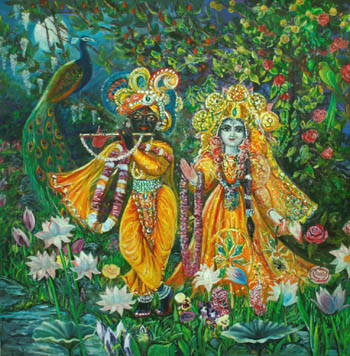
Krishna and Radha
2019
Consciousness in Science Conference
In
January 2019
I went to the Consciousness in
Science Conference in Gainesville,
Florida. The conference was
organized by the Bhaktivedanta Institute
for Higher Studies. The conference opened on the evening of
January 18, with lectures
by consciousness researchers Stuart
Hameroff and Brenda Dunne
in the auditorium
of the Harn Museum at the University of Florida. I spoke on January 20 about how my work on
archeological evidence for extreme
human antiquity relates to
consciousness studies. If, as the archeological
evidence documented in my book Forbidden
Archeology suggests, humans like us have existed for many millions of
years,
going all the way back to the very
beginnings of life on earth, this
contradicts the currently dominant theory of human
origins in the scientific world. We
therefore need to consider
alternative explanations for human origins.
But before we ask the question 'what is
the origin of human beings' we should
first ask 'what is a human?' Today, many
scientists will say that a human being,
or any other living thing, is just a machine made of molecules. As far
as consciousness
is concerned, they say it is produced by molecules in the brain. I do
not
accept that. I accept the view expressed in the Puranas, the cosmological texts
of ancient India, that the conscious self always exists; it has no
beginning,
no end. There are several kinds of scientific evidence consistent with
the idea
that the conscious self exists independently from matter. I have
reviewed that evidence in my book Human Devolution.
In my Gainesville
talk, I explained how I have been able to
communicate these ideas at mainstream
scientific conferences and inscientific publications.
Examples can be found in my book My
Science, My Religion, which is a collection of
24 papers I have presented at
mainstream academic and scientific conferences.
Later
on January 20, I gave a talk
about the exhibits
being planned (by a committee of which I am a member) for the museum
wing of the
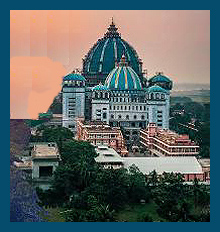
Temple of the Vedic Planetarium,
currently under construction in Mayapur,
West Bengal,
India. The exhibits will present various aspects of the
consciousness-based
Vedic cosmology.
On the evening of January 20, I was invited
to a dinner at
the home of one of the Gainesville conference organizers. There I met
Brenda
Dunne, who was manager of the Princeton
Engineering Anomalies Research (PEAR)
laboratory,
set up in 1979 by Robert
Jahn,
dean of the engineering department
of
Princeton University. PEAR
(dissolved in 2007) is most well known
for a series of experiments on the effect of conscious intention on
random
number generators. Dunne and Jahn found
that subjects were able, by conscious intention, to influence the
output of the
random number generators to a statistically significant degree. This is
evidence for psychokinesis (PK), i.e., that consciousness can operate
on matter
in ways not explained by our current understanding of physics. PEAR
also did
experiments in remote viewing. I told Dunne I had included her research
in my book
Human Devolution. The
conference was a good
opportunity to meet like-minded researchers.
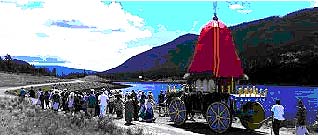 Ratha Yatra
parade
at Venables Valley - Sharanagati, British Columbia
Ratha Yatra
parade
at Venables Valley - Sharanagati, British Columbia
Wales Consultation
On Thursday July 10, I flew from Los
Angeles to London,
arriving Friday morning. I spent Friday night at Bhaktivedanta
Manor, which was donated to the International Society for
Krishna Consciousness
by George Harrison in the
1970s. On Saturday morning I was taken by car to Buckland Hall, a retreat center in
the hills of Wales. I attended
a meeting of
young scientists connected with the International Society for Krishna
Consciousness. In India, the Society is constructing
the Temple of the Vedic Planetarium
(TOVP) at
Mayapur, West Bengal, which will include
a museum wing,
with exhibits related to Vedic ideas about the origin of life and the
universe.
The TOVP Exhibits committee, of which I am a member, had arranged the
Buckland
Hall meeting to receive scientific advice on exhibits.
Bern EAA, Princeton,
New
Jersey Lecture and New England Field Trip
On September 28, 2019, I gave
a talk (titled Human Origins and
Antiquity: A Vedic
Perspective) at a meeting organized by the International Consciousness Research
Laboratories (ICRL) in Princeton,
New Jersey. The ICRL, headed by Brenda
Dunne,
is a successor to the Princeton
Engineering Anomalies Research (PEAR) group,
which had been set up at Princeton University by Robert Jahn, head of the
engineering department at Princeton, and Brenda Dunne. The PEAR group
did
groundbreaking research showing that mind can influence matter in ways
that
cannot be explained by our current laws of physics. For example, they
did
extensive experiments with random number generators (RNGs). These
devices
generate a random series of zeroes and ones. If you let the devices run
by
themselves, they generate 50 percent zeroes, 50 percent ones. But Jahn
and
Dunne had students and other subjects sit in front of the devices, and
will,
mentally, that they produce more ones than zeroes, or more zeroes than
ones.
They found that they were able to do it. They were able to cause the
output of
the random number generators to deviate, to a statistically significant
degree,
from the expected 50 percent zeroes, 50 percent ones. After some years,
the
PEAR group was closed down by the university. So
Jahn and Dunne set up the ICRL to continue their research. After Jahn
died, Dunne has carried on.
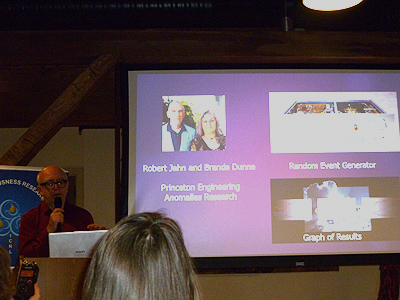 Speaking
at ICRL in Princeton
Speaking
at ICRL in Princeton
In early September, a couple of weeks before
my Princeton
lecture, I was in Bern, Switzerland,
where I spoke at a meeting of the European
Association of Archaeologists (EAA), in a session organized by
the EAA's
president. Early in the twentieth century, Albert Einstein lived in Bern, where
he was working in the customs department of the government. I visited
the
Einstein House in Bern, where Einstein was living when he wrote his
famous
papers establishing his theory of relativity. Later he accepted a
scientific
position in Germany, but when the Nazis rose to power, he emigrated to
the
United States, spending many years in Princeton, New Jersey, at the
Institute
for Advanced Studies. On the day of my Princeton lecture, one of the
ICRL
people drove me from my hotel to the lecture venue. In the car, I
mentioned
that my last event had been in Bern, where Einstein had lived, and now
my next
event was in Princeton, where Einstein had also lived. My driver said
she could
take me see the house where Einstein lived and the Institute where he
worked.
These places were right on the way to the lecture venue. So we stopped
by those
places.
At the
lecture hall, I met Brenda
Dunne. I gave my talk,
beginning with archeological evidence for extreme human antiquity, and
moving
on to the scientific evidence showing that the conscious self exists
apart from
matter, and can act on matter in ways modern science cannot explain. In
that
connection, I spoke about the relevance of the work done by Robert Jahn
and
Brenda Dunne, which I found to be compatible with the Vedic ideas that
inspire
my work. The lecture was well attended, and there were lots of
questions after
the talk.
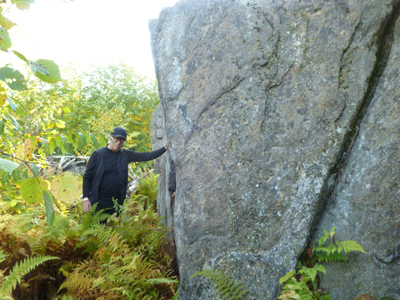 Investigating a
megalithic rock in New England
Investigating a
megalithic rock in New England
After the Princeton
lecture, I went on an archeological field trip in Connecticut. Over the
past couple of years, my research assistant has been in touch with an
alternative archeology researcher there, Geoffrey Whittam. He has
extensive knowledge of mysterious dolmens, standing stones, stone
walls, stone
chambers, and stacked stones all over Connecticut and other places in
New
England. He regards them as evidence for a lost civilization, preceding
the
European settlers and native American tribes. My research
assistant, who
attended the Princeton lecture, along with a film producer friend,
suggested
that the three us should take up Geoffrey's offer to show us some of
his finds.
So we spent a day with Geoffrey, driving all over the state of
Connecticut, and
hiking deep into forests, up and down hills, to view the standing
stones, etc.,
at many different sites. Although skeptics will certainly have
explanations for
some of these objects, I am keeping an open mind about them. Certainly,
I
accept the idea that humans have existed in the Americas for much
longer
periods of time than those accepted by modern science (about 30,000
years). In
my book Forbidden
Archeology,
I have documented archeological evidence
showing that humans have existed for millions of years in the Americas.
One of
the questions I have about the New England objects, if they are
accepted as the
work of humans, is "how old are they?"
2021
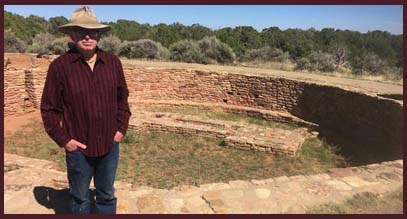
Great
Kiva Heritage Site in the Four Corners Region
From September
17 to September
24, I
traveled to Montezuma
County,
in the southwest corner of Colorado, to meet with Dave
Edwards,
one of
my correspondents, and filmmaker Robert
Dakota.
Dave had started writing to me
late last year (2020). He told me about a site he had discovered on his
property in rural Colorado. At this site, he had found large pieces of
stone
that he thought represented people and animals. He linked his site with
the
local Native American people, the
Hopi, and
thought the site had a spiritual
facet to it, in that it contained portals to other dimensions of
reality. He
wanted me to come and see the site, so I agreed to do it, even though I
did
have some doubts about it. I figured I should give Dave a fair hearing
and
experience his discovery firsthand. After all, that's what I ask
archeologists
to do in connection with my work, give it a fair hearing and have a
look at the
evidence. I spent a few days, visiting the site and some local Native
American
archeological sites. One of the days was the fall equinox, and Dave
held a
ritual ceremony, based on Native American practices, at his site. Part
of the
ritual involved an attempt to experience the portal aspect of the site.
I
participated and experienced a strong sensation of immortality. Robert
filmed
some of my evaluations of the site, and an excerpt can be seen at this
link: https://youtu.be/5D6z9QRIrBI
On October 12th
I flew into Boulder to do some
interviews
for the Ancient Civilization
series of video programs produced by
Gaia TV. I spent the following afternoon at the studio doing the
interview, and the next
day flew back to LA.
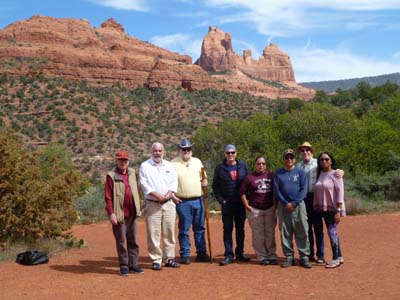
Picnic lunch with some of the EO IV
presenters & attendees at the Red Rocks Trailhead
The
next morning, October 14th, I
left LA for Sedona, Arizona,
to give a talk at the Earth Origins IV
conference. Sedona, with its red
rock canyons, mesas, and towering
formations, is a magical place. My talk was titled Native Americans, Time, and
Archeology. The Native American scholar Vine Deloria, Jr., quoted
extensively
from my book in his book Forbidden ArcheologyRed
Earth, White Lies. Like him,
many Native American people do not accept that humans evolved from apes
or that
the Native American people first entered the Americas less than 20,000
years
ago. I have documented archeological
evidence that supports these ideas, and because Vine Deloria, Jr.,
himself a
Native American, had endorsed my work, I felt comfortable
in presenting it to an audience
that included Hopi and Zuni
elders, who later bought some of my books. I returned to LA a day later
than I
planned because high winds delayed my flight from Flagstaff to Phoenix,
causing
me to miss my connecting flight to LA. So the airline put me up for a
night in
a Phoenix hotel, and rebooked me on a flight to LA the next morning.
2022
Living Truth Summit
On March 31, I traveled from
Los Angeles to Mt. Shasta in
northern California. The snow covered peak of this extinct volcano
dominates
the surrounding area. For the local Native American tribes, the
mountain
remains a place for sacred rituals. Some come to experience the natural
beauty of the place. And others claim to have encountered ascended
masters,
extraterrestial beings, and refugees from lost civilizations such as
Lemurians.
Such beings are said to reside in a crystal city within Mt. Shasta.
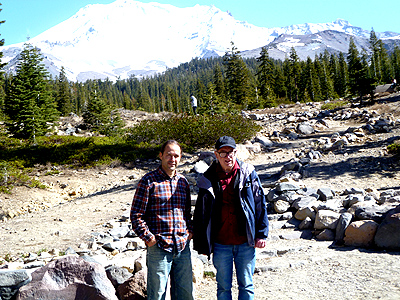 Ami
played music at the conference and showed me Mt. Shasta
Ami
played music at the conference and showed me Mt. Shasta
At
Mt. Shasta I was a speaker at a conference called the
Living Truth Summit. My talk was titled “Excavating the Eternal: Psychic
Archeology in India.” Today
archeology is
mostly a science of the dead, fixating on bones and stones. But some
archeologists have shaken things up using psychic techniques to explore
nonmaterial dimensions of the past. This use of psychic techniques has
a long
history. Hundreds of years ago in India, many saints, mystics, and
yogis used
information from dreams and visions to excavate and recover long lost
sacred
objects and sacred sites that open portals to the eternal. The
talk was well attended and favorably received. The final
part of the conference was a ceremony at Mount Shasta. It was held at a
private
park at the base of the mountain, called the Michael Mary Mandala. Several
stone circles reminiscent of ancient stone circles in Europe have been
erected
on the site, including circles representing the seven chakras, or
energy
centers, of the human body. The ceremony was for the activation of a
crystal
within Mount Shasta. It was good spending
time at the mountain. The atmosphere
was Himalayan. I was reminded of the accounts in the Bhagavata Purana,
also
called the Shrimad Bhagavatam,
of sages gathering in the Naimisharanya Forest
to contemplate what they could do for the spiritual welfare of people
in the
darkness of this present age.
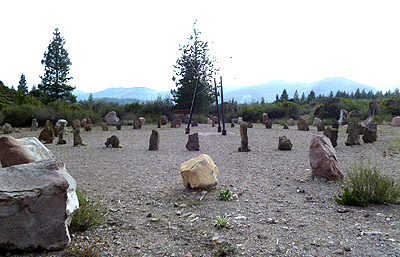 Site
of the Tetrahedron at the Michael Mary
Mandala
Site
of the Tetrahedron at the Michael Mary
Mandala
Science of
Consciousness Conference
Later
in April, I attended the Science of
Consciousness conference, which was held at a resort near Tucson, Arizona. The
conference is one of the main gatherings of scientists and researchers
exploring the nature of consciousness. For scientists who believe
consciousness
is produced by matter within the brain, the key is to identify the
neural
correlates of consciousness (NCC). The brain is made of cells called
neurons.
If consciousness is produced by neurons, scientists should be able to
find the
exact set of neurons that produces consciousness. But
at the conference one of the leaders of this effort, Christof
Koch, admitted that finding this goal has proved to be elusive. A
leading
philosopher of science, David Chalmers,
spoke about his recently published book
on virtual reality, which he said offers possibilities for
scientifically
plausible explanations of consciousness, animism, and creation. A
surprising
feature of the conference was the number of scientists at mainstream
universities and other institutions conducting research into the use of
psychedelics as treatment for physical and mental disorders. In a
poster
session, I made a presentation comparing the effects of psychedelics to
the
vision of the universal form described in the Bhagavad-gita.
Summer
2022
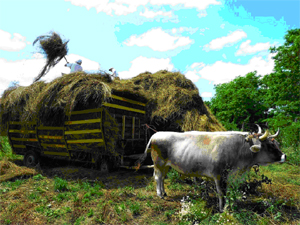
Using
ox power to make hay at Krishna Valley
On June
29 I went to
the Los Angeles airport to board a British Airways (BA) flight to
Heathrow
airport in London, connecting the next day to a flight to Prague. I was going
to Prague to attend a meeting of the World Archaeological Congress. The
BA
flight out of LA was delayed several hours so I missed my connecting
flight to
Prague. BA booked me on standby for the next flight (the last one) the
evening
of June 30. I did not get a seat on that flight. I went to BA customer
service.
They said the next flight to Prague would be two days later. Normally,
they
would have given me a hotel room for the two nights. But they had run
through
their supply. I had to book my own hotel room. They said I could be
reimbursed.
Yeah, sure, I thought. So now it is pretty late. I try the hotel in the
terminal. It’s full. I try on my phone to get a room in hotels near the
airport. They are all 700 dollars or more a night. Finally I find a
room in a
hotel in Farnsborough, a little outside London, for 130 dollars a
night. But a
taxi out there is 120 dollars, and 2 days later the same amount to
return to
the airport. Eventually, I did get reimbursed for all of my expenses.
In
addition I received substantial compensation. To do all this, I had to
make a
claim online, submitting all receipts, etc. It was time consuming, but
I wasn’t
going to let this go. So I got to Prague the night before the
conference
opened. I presented a paper about my work with the museum and
planetarium
exhibits in a project in India called The Temple of the Vedic Planetarium.
This
presentation was an attempt to preserve and pass on to the future the
cosmology
of the Gaudiya Vaishnava tradition in India.
After the conference,
I traveled by train
from Prague to Budapest, in
Hungary. I visited some friends, members of the Hare Krishna
movement there. I visited the movement’s eco village (called Krishna Valley) in
southern Hungary. It is off the grid, and is self sustaining, producing
its own
fruits, vegetables, grains, and milk products. Especially interesting
was a
project to have oxen turn a wheel that transmits mechanical power
through
transmission gears to power machines for cutting wood, grinding grain,
etc. I
gave a talk about my presentation in Prague at Krishna Valley. I gave a
similar
talk at the Budapest Hare Krishna center. I also met with faculty
members of
the Bhaktivedanta College in
Budapest. After I returned to Los Angeles, I went
to Seattle, where I lectured
on meditation and the soul at Heart
Center for Awakening yoga studio, and
met with friends and supporters.
Vedic
cosmology conference at Govardhan Eco Village
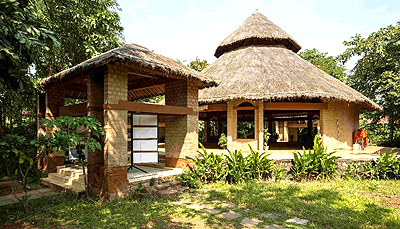
Govardhan Eco Village
On October
31, 2022, I flew from Los Angeles to Mumbai, India (via JFK airport in
New
York, and Doha in Qatar) to take part in a conference on Puranic and
Siddhantic
cosmology. The Puranas and the Siddhantas are the two main sources of
knowledge
about the Vedic cosmology of India. The Siddhantas present information
needed
to calculate the observable movements of celestial bodies. It is in
many
respects similar to modern astronomy. The Puranas present a wider
cosmological
vision, incorporating features not observable by ordinary human sense
perception. I was invited to this conference because I am a member of a
committee working on the development of exhibits for a museum in the Temple of
the Vedic Planetarium (TOVP) in Mayapur,
West Bengal. My exposition was about
presenting the TOVP cosmology museum as a cultural heritage project,
designed
to preserve for future generations the Vedic cosmology, which promotes
values
that can be helpful in solving the environmental crisis.
The
conference was held at the Govardhan Eco Village, about 3
hours by car north of
Mumbai. Imagine an eco friendly resort and learning center superimposed
on a
sustainable agriculture project in the forested, hilly countryside of
Maharastra—that’s Govardhan Eco Village, a project of the International
Society
for Krishna Consciousness. I enjoyed my weeklong stay there, especially
my tour
through the replica of the Vrindavan region of India, revered as the
place
where Lord Krishna appeared.
On November 7, I traveled to the Mumbai
airport
to begin my return journey to LA (via New Delhi and New York).
2023
Visit to
Mayapur
On January
30, 2023, I flew from Los Angeles to Kolkata, India. From Kolkata I
traveled to Mayapur, West Bengal.
The first time I visited Mayapur was in 1979. Mayapur,
located on the bank of the Ganges in rural West Bengal, is the place
where an
avatar of God named Chaitanya Mahaprabhu
appeared a little over 500 years ago.
He taught love of God and spread the chanting of the Hare Krishna
mantra, which
he said would go to every town and village in the world. In the years
1965 to
1977, my guru, His Divine Grace A. C. Bhaktivedanta Swami Prabhupada,
fulfilled
this prediction. Chaitanya
Mahaprabhu’s appearance day is calculated by the lunar calendar. It
occurs on
the full moon of the month of Phalguna, which this year corresponds to
March 6,
2023. I arrived
in Maypur several weeks before that to take part in meetings, give
lectures,
and go on some pilgrimages to sacred sites in the region surrounding
Mayapur.
Some of the meetings were connected with the Temple of the Vedic Planetarium
museum project, the planning of which is being overseen by a committee
of which
I am a member. On the
appearance day of Chaitanya Mahaprabhu, we all fasted until moonrise.
Then we
enjoyed a vegetarian feast.
|
During the
last days of my stay in India, I went to the town of Patna in the state of Bihar. I wanted to see if I could
find a specific temple, which was of interest
to me because of its connection with what I call transcendental
archeology.
There are cases in which a person will find a lost sacred object or
place by a
dream or vision. In this particular case, about five thousand years
ago,
according to traditional sources, there was a king named Jarasandha. He
wore as
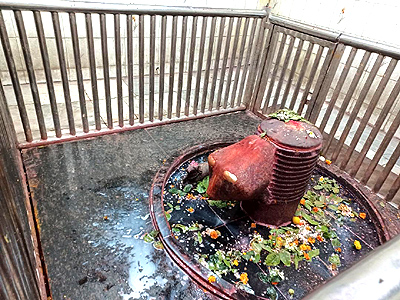
an amulet a Shiva linga. The
linga is a short stone pillar. Jarasandha lost the
Shiva linga in the Ganges River near Patna. Several centuries later,
Man Singh,
a government officer, was traveling by boat on this stretch of the
Ganges. His
boat got stuck on a sandbar. In a dream, he was told that if he
excavated the
lost Shiva linga and built a temple for it, his boat would be freed and
he
could continue on his journey. He did as he was told. The temple and
Shiva
linga are still there in the countryside about an hour’s drive by car
from
Patna. It wasn’t easy finding the place, but finally I was able to see
this
example of transcendental archeology. From Patna
I went back to Mayapur for a day, and then went to Kolkata and started
on my
flights back to LA
<> 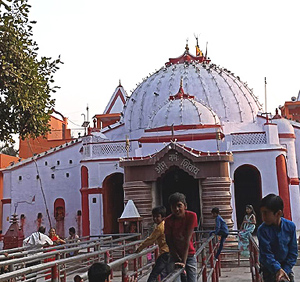
The temple at Patna
The Shiva Linga at Patna
Two
Conferences
Shortly
after my return to LA, I gave two talks and participated in a panel
discussion
at the Biomed Expo, which was
held in a hotel near the LA airport March
24-26.
My Media Manager arranged to have the Temple
Bhajan Band sing the Hare Krishna
mantra during the opening ceremony of the conference. My first talk was
on my
book Forbidden Archeology, the second
on Human Devolution.
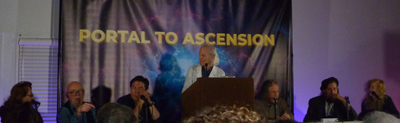 Speaking at the
Portal to Ascension Panel
Speaking at the
Portal to Ascension Panel
On April 20, 2023, I traveled from LA to San
Diego by Amtrak train. I was there for a conference which
started on Friday,
April 21. The venue was the Marina Village Conference Center on Mission
Bay.
The conference, organized by a group called Portal to Ascension, was called the
Ascension Conference. During the three day conference, I took part in a
panel
discussion on ancient human civilizations, along with other alternative
history
researchers, such as Dr. Robert Schoch.
The next day I gave my lecture, which was
about the Temple of the Vedic
Planetarium and how it will be an ascension portal to higher realms.
Finally, I gave a workshop on Science
Meets the Vedas, which included mantra meditation.
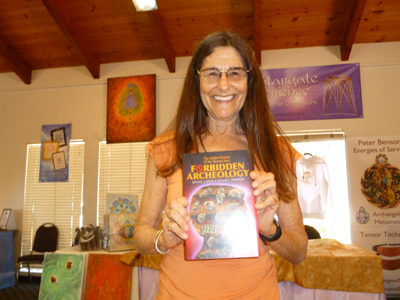 Katie Astor shared
accounts of her archeological finds in the San Diego area
Katie Astor shared
accounts of her archeological finds in the San Diego area
The
Pacific NW and Vancouver
On June
24, 2023 I spoke at an event called Sage the Earth at the
Vancouver
center of the International Society for Krishna Consciousness. Sage
the
Earth suggests that the solution to our environmental crisis can be
found in the world’s traditional wisdom
systems. I explained how the Vedic tradition envisions the world as a
form of
God. With this vision, we learn to treat nature, including all living
beings,
with respect and reverence. I spent a couple of peaceful days at a
cabin in the
mountain forests before returning to LA.
Encinitas
Conference
On August
17, 2023 I traveled by Amtrak train from Los Angeles south to
Solana Beach,
a coastal town near Encinitas, where I would spend the next three days
at a
conference on consciousness studies. The conference, called Neuroscience
Needs A Revolution to Understand Consciousness, was organized by
the
California Institute for Human Sciences and the Center for
Consciousness
Studies at the University of Arizona. I
was there as an observer for the Bhaktivedanta Institute for Higher
Studies. In
my report, I noted there were many theories trying to explain how
consciousness
is generated from matter. None of them has
succeeded in becoming the
dominant one. This leaves the door open for a consciousness-based Vedic
alternative.
Zurich
and Budapest
On September
25, 2023, I flew from Los Angeles to Zurich, Switzerland, arriving the
next
morning. I stayed in a guest room at the Zurich Hare Krishna temple. I
was in
Zurich at the invitation of the organizers of the conference Synthesis
of
Science, Spirituality, Art, and Culture for World Peace. I was the
chief
guest and keynote speaker. In my opening remarks I said such a
synthesis is
urgently needed. I pointed out that the Bulletin of the Atomic
Scientists,
formed in 1945, had this year set its Doomsday Clock at 90 seconds to
midnight,
midnight being worldwide catastrophe. This is the closest the world has
been to
the use of nuclear weapons in war since World War Two. Science has
developed
the ability to make nuclear weapons. But it cannot by itself decide
moral
questions such as the following. We can make nuclear weapons but should
we? And
if we do make them, should they ever be used? And if they are used, how
should
they be used? Such questions can be answered only by a science guided
by
authentic spirituality.
In my
keynote address the Temple of the
Vedic Planetarium (TOVP), a project in India
that I am personally involved in, was given as an example of a
synthesis of
science, spirituality, art, and culture for world peace. The TOVP was
conceived
of by my guru, His Divine Grace A. C. Bhaktivedanta Swami Prabhupada,
in the
1970s. He wanted the TOVP to demonstrate to the world that the Vedic
cosmology
was relevant to the modern world and its problems, such as the danger
of
nuclear war. One of the essential points is the unity of all people as
parts of
God. In other words, we are not our material bodies, which we call
American,
Russian, Chinese, etc. Instead, each of us is a soul within a material
body,
and on that level we are all part of the same spiritual family of God.
This
idea, presented in the TOVP by means of science, spirituality, art, and
culture, removes a key cause of conflict—false identification with
violent,
divisive nationalism.
In Zurich
I also gave a talk at the ETH (Eidgenössische Technische
Hochschule Zürich).
Also called the Swiss Federal
Institute of Technology Zürich, it regularly
ranks among the ten top universities in the world. It specializes in
the STEM
subjects—science, technology, engineering, and mathematics. Sixty
students
attended my lunch-time talk, which was on descriptions of flying craft
(vimanas) in the Vedic literature. After the talk, there was ample time
for
wide ranging questions on many aspects of Vedic cosmology. Later I
spent an
afternoon at a Zürich café, having talks with a few
intellectuals. I also gave
some talks at the Zürich Hare Krishna temple.
On October
3, 2023, I flew from Zürich to
Budapest, Hungary. I was there to speak at a
conference on Vedic cosmology organized by the Bhaktivedanta College, which is
associated with the Hungarian Hare Krishna movement. My topic was the
Temple of
the Vedic Planetarium and how it helps people to understand and
appreciate the
Vedic cosmology, which is consciousness-based, unlike modern scientific
cosmology,
which is matter-based. While in Budapest, I gave a talk to the graduate
students at Bhaktivedanta College about how the universe can be
perceived as a
form of God, as a first step in comprehending the original form of God
in the
spiritual world. I also gave a welcoming talk at a cultural event for
first
year students.
On
October 11, 2023, I flew back to
Los Angeles.
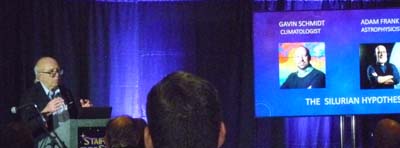
Lecturing at
Stairway to the Stars in Las Vegas
Las Vegas and Gainesville
Conferences
<> On Thursday November 9,
2023, I flew
from LA to Las Vegas for the Stairway to the
Stars conference, which was held at the Luxor hotel and casino.
The massive
dark grey glass and steel pyramid structure of the Luxor is one of the
most
recognizable features of the Las Vegas Strip. A colossal sphinx
greets visitors
as they enter the Luxor Resort. After I checked into my room, I went
out to
locate the conference venue. It took
awhile to orient myself in the maze of walkways, shops, gambling areas,
and
restaurants, as crowded as a Cairo bazaar. For the next two days I
spent time
at my author table, meeting people, attending lectures, and giving my
own. Here
is the title and a synopsis of my presentation: The
Silurian Hypothesis and Forbidden Archeology
In recent
years, astrophysicists have proposed that a technologically advanced
civilization built by humanoid reptilians existed on earth hundreds of
millions
of years ago during the geological period called the Silurian. Such a
civilization could explain periods of global warming in the distant
past. This
is called the Silurian Hypothesis, inspired by episodes of a BBC
science
fiction television series called Dr. Who that aired in the 1970s. The main character, Dr. Who, encounters
humanoid reptilians, called the Silurians, who had been in suspended
animation
in deep caves since the Silurian but have been awakened by the
activities of a
scientific research station on the surface. The idea of humanoid
reptilians
living deep inside the earth is echoed in the Puranas, which
tell of the
Nagas, humanoid serpents who dwell in a subterranean realm. It’s
interesting
that modern scientists are considering the possibility of civilizations
existing many millions of years ago. In this case, because scientists
don’t
think humans existed millions of years ago, they have substituted
humanoid
reptilians. However, as documented in my book Forbidden Archeology,
there is archeological evidence showing that humans existed in these
distant
times. Evidence for a Silurian civilization could be difficult to
detect. It
might include things like traces of compounds that do not occur
naturally
rather than fossil bones and artifacts.

The Bhaktivedanta Institute for Higher
Studies headquarters in Gainesville
<> On
Monday,
November 13, I flew back to LA. On Wednesday I flew out to Gainesville, Florida
for a conference on Vedic cosmology organized by the Bhaktivedanta
Institute
for Higher Studies (BIHS). The conference was held in the
headquarters of the BIHS, a
stately mansion that was once the home of a president of the University
of Florida.
Here is the title of my talk and a synopsis:
Exoarcheology
and Archeoastronomy: Possibilities for Vedic Cosmology Research
Two fields
of research invite the attention of those interested in Vedic
cosmology:
exoarcheology and archeoastronomy. Archeoastronomy is the study of
physical,
cultural, and textual remains that provide evidence for astronomical
knowledge
possessed by people in the earth’s past. Connections between
astronomical
events and archaeological remains may also provide a means of dating
these
remains. Once relegated to “fringe science,” archeoastronomy has now
become a
small (but growing) recognized field of study in archeology.
Exoarcheology is
less well known. It is related to the wider field of exobiology, the
study of
life on celestial bodies beyond this earth planet. Because over the
past couple
of decades, astrophysicists have detected thousands of planets capable
of
supporting life, orbiting stars in other solar systems, the field of
exobiology
is becoming more prominent. NASA, for example, has an exobiology
department.
Professional archeologists are now discussing what they will do with
artifacts
found on the moons and planets of our solar system and beyond. The
United
Nations Outer Space Treaty defines ownership of any artifacts recovered
from
other planets. Of course, some of this is stuff we have sent there, but
archeologists are seriously discussing what they will do if they find
something
that did not come from the space programs of our earth planet.
Prominent
scientists such as astronomer Avi Loeb
are actively researching such things.
The Bhaktivedanta Institute should study the possibilities. As we move
into
space, we are also moving in the direction of the worldview of people
of past
civilizations and cultures, such as the Vedic culture and its
cosmology.
Heading into the future, we may arrive in the past.
After the
conference, I stayed for several more days to participate in working
sessions
with BIHS scientists who are providing content and guidance for
exhibits on
Vedic cosmology for the museum wing of the Temple of the Vedic
Planetarium, now
in the final stages of construction in India.
2024
Science of Consciousness Conference
From April
21 to April 26 2024, I was at The
Science of
Consciousness (TSC) conference, which was held at Loews Ventana
Canyon Resort
near Tucson, Arizona. TSC is a
major international conference, attracting the
top scientists and philosophers involved in consciousness studies. The
2024
meeting was its 30th. In attendance in 2024 was David Chalmers, who was
present
at the First TSC conference ub 1994. At that time, he set the agenda
for
consciousness studies by defining "the hard problem of consciousness"
and declaring that science had not solved it. In another early meeting
of the
TSC, neuroscientist Christof Koch bet David Chalmers that science would
solve
the hard problem of how you get consciousness, i.e., subjective
awareness, from
matter within 20 years. In his talk in 2024 Koch admitted he lost the
bet.
The
1994 TSC conference is
sometimes said to be the first one on consciousness. David Chalmers
pointed out
that the first consciousness studies conference was not the 1994 TSC
conference. Rather it was the
1991 conference organized by the
Bhaktivedanta Institute. Members of the Bhaktivedanta Institute for
Higher
Studies had a significant presence at the 2024 TSC conference. They
conducted a
four hour workshop session, at which they presented an approach to
consciousness studies that includes
matter, mind, and consciousness.
 Chatting with Jared
Murphy while conference attendees peruse books
Chatting with Jared
Murphy while conference attendees peruse books
A Conference on Ancient America
On October 5, 2024, I was
keynote speaker at the Ancient
Artifact Preservation Society
conference on
Ancient America. The conference was held at a casino resort owned by a
Native
American Indian tribe in a remote area of northern Michigan's Upper
Peninsula.
My talk was titled The Most Ancient
Americans and Their Artifacts. I began by
quoting from a book by the late Vine
Deloria, a Native American Indian scholar.
The book was Red
Earth, White Lies, which Deloria disagrees with the mainstream
scientific accounts of human evolution and the peopling of the
Americas. He
said the Native American tribes were present here long before the
20,000 years
accepted by mainstream archeologists. Deloria made some favorable
comments
about my book
Forbidden Archeology, in which I documented discoveries
supporting his view. In my talk I reviewed some of these discoveries.
The
conference was a good place to meet
fellow researchers, talk with people who purchased my books, and make
contacts
for for media interviews about my work.
I also had a chance to experience the sparsely populated Upper
Peninsula's
extensive forests and wild Lake Superior
shore.
2025
From January 17-19, 2025 I gave a
presentation called Speciation and
Heredity:
Point of Contact
Between Gaudiya Vaishna Thought and Darwinian Evolutiontion at a
conference called Evolution 2025: Fact, Fiction and Philosophy held at
the Bhaktivedanta Institute for
Higher Studies in Gainesville, Florida.

Presentation
at the Conscious Life Expo
The weekend of February 7-9, 2025 I took part in
the Conscious Life Expo, which
was held at the airport Hilton in Los Angeles. On Friday evening I was
part of a panel on ancient civilization hosted by radio talk show host Jimmy Church, who put questions to
the panelists. He asked what was the most amazing place I'd ever been
to. I replied, "Anywhere you can see the stars at night." Because of
light pollution and air pollution most people can no longer see
much in the sky at night except for the moon and perhaps two or three
of the brightest stars and planets. We have therefore lost touch with
the cosmos and
the sense that there must be some ultimate conscious source of the
celestial bodies that move in such an orderly fashion. It is especially
significant at an event called the Conscious Life Expo that we
acknowledge we are conscious selves in a consciousness based universe.
Afterwards there was an awards ceremony. I received an award for my ground-breaking research in human
origins and antiquity. It felt good to get some recognition in the
alternative science field. On Saturday I had a book signing event, and
on Sunday evening I gave my talk, titled Forbidden Archaeology and the Consciousness
Paradox. Scientists have never gotten around to demonstrating
their paradoxical claim that consciousness can be produced by
unconscious matter.

The Jantar
Mahal
On February 13 I flew on
Philippine Air to Manila and Bangkok, and then connected with a flight
on Thai Airlines to Kolkata, where I got a taxi ride
to Mayapur in West Bengal, a sacred town on the
Ganges about 90 miles north of the airport. I am part of a group that
is designing exhibits for the Science
Museum wing
of the Temple of the Vedic Planetarium.
The museum will present Vedic cosmology, especially the idea that we
exist in a consciousness based universe. After a week in Mayapur, I
went with members of our group to New
Delhi for meetings with the museum design consulting company,
which is helping us translate our exhibit ideas into working form.
While in New Delhi we visited the Jantar
Mahal, a traditional astronomical observatory. Stone structures
allowed astronomers to make sophisticated astronomical measurements.
From New Delhi I flew back to LA, arriving on March 2, 2025.
New Living Expo - San Rafael
In February, when I
was a speaker at the Conscious Life
Expo in Los Angeles, Ken Kaufman, the organizer of the New Living Expo, invited me to be a
speaker at that event, which was to be held in San Rafael in Marin County, California, May 9-11, 2025. I committed to
giving a 45 minute lecture on Extreme Human Antiquity,
giving a 90 minute workshop on Decoding
Archeological Reports, and participating in a panel on Ancient Civilizations. Ken also
provided a booth in the exhibit area for selling my books. I flew into
the San Francisco airport on Friday
June 9. A conference car took me on a scenic drive through Golden Gate Park and then over the Golden Gate Bridge to San Rafael. On Saturday morning I
gave a talk on Extreme
Human Antiquity, the title of my new book, which documents
anomalous archeological discoveries that came to my attention in the
years after the publication of my book Forbidden Archeology.
In my talk I previewed some of the cases in Extreme Human Antiquity
that greatly exceed the 300,000 years mainstream archeology now accepts
for the first humans like us. On Sunday morning I participated in the
panel discussion on ancient civilizations and described the cosmology
of Vedic civilization. Later that day I offered a workshop on decoding
archeological reports. The first point I made is that archeological
discoveries do not really exist in the world of science until a report
giving the details is published. We are especially looking for reports
including evidence for humans older than the mainstream timeline
allows. There are some
reports that support extension of the human timeline. How credible are
they? We should know how to decode them so we can properly understand
what they mean. Reports that anticipate possible objections and rule
them out are stronger than those that do not. What about reports that
claim to debunk reports that extend the timeline? Those that simply
list possible sources of error are weaker than those which demonstrate
a source of error that actually did exist in the place under
consideration. When I wasn't at my speaking events I joined my media
manager at our book table in the exhibition hall. I enjoy meeting
people who stop by, whether or not they purchase a book, although a
good many do. This expo also facilitated connections for future media
outreach.
 With a fan at New
Living Expo
With a fan at New
Living Expo
Sarasota, Florida
A few weeks ago, I
received an invitation from Mark Beall,
CEO of Beall, Inc., a family owned retail business which operates over
600 household goods stores in the United States, to appear on his Limitless podcast . I accepted
his offer to fly from LA to Sarasota to shoot a Limitless episode. When
I arrived in Sarasota on the evening of June 3, after checking into a
hotel, I walked to a nearby vegan friendly restaurant called Lila.
There I had a wonderful dinner and conversations with Matt, his wife
Krystel, and podcast producer Ryan. The next morning, Ryan took me from
my hotel to the Limitless studio, where we met Matt, who showed me his
collection of Egyptian stone bowls. I first heard about these bowls
from John Anthony West many
years ago. The walls of some of these delicate bowls are very thin.
Exactly how they were made remains a mystery. It was amazing to hold
them. The podcast was videotaped in two sessions, covering a wide range
of topics, which included archeological evidence for extreme human
antiquity, Vedic cosmology, paranormal phenomena, UFOs, consciousness,
identity, vimanas (spaceships described in the Vedic literature), and
more. The next day I flew back to LA.
Darwin, Australia
Late at night on
Saturday, June 14,
2025, I left LA on a Qantas flight to Australia. After landing
in Sydney and
clearing customs, I made my way to the domestic terminal and got
my long
flight to Perth on the west
coast of Australia. The major cities are on the
coasts. Going from Sydney on the east coast to Perthon the
west
coast is like going from LA to New York. Perth has the reputation
of being
the most isolated city on earth. I stayed in a suburban estate, the
residence of a married couple who, like me, are long-time
members of the Krishna consciousness movement. I gave a talk
about my latest book, Extreme
Human Antiquity, at a fashionable downtown
hotel. On another evening, I spoke at the Indian Consulate. Finally, I
spoke at a gathering of members of the Krishna consciousness movement.

With Dr. Soumya Gupta at the Indian
Consulate in Perth
Then
I flew from Perth to Darwin in
northern Australia, for the tenth meeting of the World
Archaeological Congress (WAC 10), which was held at Charles
Darwin
University. The WAC 10's isolated location was deliberate.
It
allowed contact with Australian aboriginal people.
I participated in a didgeridoo sound healing session and
went on
a day long tour of aboriginal rock art. We also visited a river, where
we
expected to see some of the region's huge
crocodiles, but they kept
out of sight. In my official contribution to
the conference,
I gave a talk on an example of an indigenous
archaeological tradition
in 16th century India. My book Extreme
Human Antiquity was featured in
an
international book event held at the conference. One day I was
walking through the crowded hallways feeling
anonymous, and
one of the younger archeologists recognized me from <> interviews on the web. He
rushed up
and asked,
"Are you the Michael
Cremo?" We had some good talks.
On June 21 I flew from Darwin to Brisbane, and from there
back to LA.
Barcelona
Only
three days after I returned to LA from Australia,
I was on my way to Barcelona, Spain for The Science of Consciousness, an annual
conference for scientists and philosophers interested in the study of
consciousness. I presented a paper there titled Darwin and
Consciousness.
Darwin understood that the origin of consciousness posed a problem for
his
theory of
evolution. Being a materialist, he believed consciousness was secreted
by the
brain. But he could not explain how. He said the origin of
consciousness is a
problem for scientists of the distant future to solve. The
distant
future has arrived but the solution has not. On the last day
of the
conference, a Spanish scientist (Frederico Faggin) said that theories
of
consciousness are like toothbrushes. Everyone has one and won’t use
anyone
else’s. That sums up the current state of consciousness studies. There
are many
theories, none of which have become dominant. That means the field is
wide open
for a Vedic alternative.
2026
I went to India, flying out of LA on February 1, 2026
on Qatar Airlines to Doha, where I got a connecting flight to Kolkata, arriving
at 2 am on February 3. After staying overnight at a hotel
near the
airport, I went by car to Mayapur (in West Bengal, India) the next day
at noon.
The ride took about two hours on the new highway.
Mayapur
is an
important place for me. In 1486 an avatara of Krishna named Chaitanya
Mahaprabhu appeared here. His mission was to introduce the
congregational
chanting of the Hare Krishna mantra. By this chanting one directly
contacts God
and experiences the highest pleasure. He predicted the chanting of
Hare
Krishna would spread to every town and village in the world. In 1965,
that
prophecy was fulfilled when my guru,
His Divine Grace A. C. Bhaktivedanta Swami
Prabhupada, brought the chanting of the Hare Krishna mantra to
New York City.
In the following years the movement spread all over the world. He
established a
center in Mayapur so that his disciples from all over the world could
come
together at this sacred place. In the days leading up to the
celebration of the
appearance day of Chaitanya Mahaprabhu, on the full moon day (March 2),
I
attended meetings of the movement's governing body as an
observer. I am
also a member of the group designing exhibits for a museum and
planetarium
theater, part of the Temple of the
Vedic Planetarium, a project my guru
envisioned. So I took part in some design meetings. I also visited some
sacred
places related to Chaitanya Mahaprabhu. I originally planned to return
to LA on
March 6, but my flights were cancelled because of the Mideast
war. I
finally got out on March 18.
|